Disclosure at the Unternehmensregister, right from your AI assistant
Your assistant reads the annual accounts from PDF, Word or Excel. Uregistry checks every section formally and builds the XML file you upload on the Publikations-Plattform, so you pay no conversion charge.
Free during the closed beta · formal checks, no advice
Uregistry MCP works with
Uregistry fits your AI setup and runs in the assistant your company already uses.
- Claude
- ChatGPT
- Le Chat
- Gemini CLI
- Langdock
- Microsoft Copilot Studio
- Claude Code
- Cursor
- Codex
The annual accounts are done. Filing them still costs time and money.
- 01
Conversion charge for PDF and Office
The Publikations-Plattform accepts PDF, Word or Excel but converts them for a charge: 1.75 ct per character plus VAT. At 20,000 characters that is €350 net.
- 02
XML takes expertise
The only way to avoid the charge is XML following the Bundesanzeiger Verlag's schema. Building it takes technical knowledge or expensive software.
- 03
No proof copy
The Publikations-Plattform sends no preview before publication, and a publication cannot be withdrawn. Mistakes show up once they are public.
- 04
Fixed deadline
Filing is due no later than twelve months after the balance sheet date (§ 325 (1a) HGB). After that, the Federal Office of Justice can start fine proceedings.
Four steps to the filing file
- 01
Connect
Add Uregistry to your AI assistant as a connector and sign in with your email address.
Connector address:
https://mcp.uregistry.de/mcp
Setup guide → - 02
Clarify obligations
The assistant asks for legal form, fiscal year and size figures. Uregistry shows thresholds and required parts with their sections of the HGB. You or your tax adviser confirm the size class.
- 03
Transfer and check
Drop the accounts into the chat as PDF, Word or Excel. The assistant transfers them section by section; Uregistry checks each one formally and says exactly what does not fit.
- 04
Preview and upload
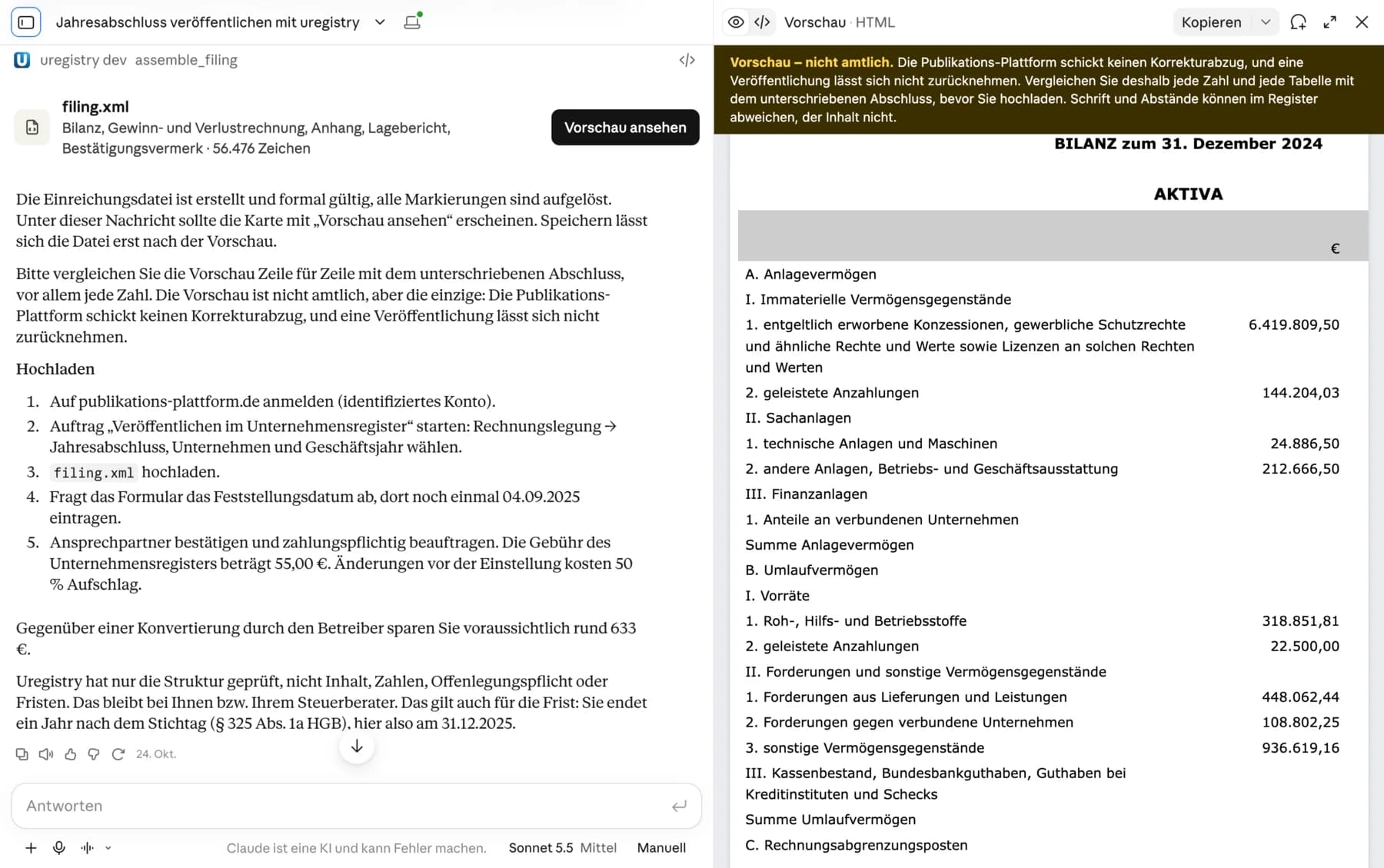
You compare the preview with the original and receive the XML file. You upload it yourself on the Publikations-Plattform.
Why Uregistry
For GmbH, UG, AG and GmbH & Co. KG that disclose or deposit their annual accounts themselves. The focus is on micro and small companies; medium-sized ones are supported.
Backs up your AI assistant
Your assistant can write XML, but it cannot check it formally against the schema and the Publikations-Plattform's rules. That is what Uregistry does, right inside Claude, ChatGPT and other MCP assistants.
No XML knowledge needed
You put your existing documents into the chat. The XML file following the Bundesanzeiger Verlag's schema is built in the background.
Preview before upload
You see the content of your filing as it will be published and compare it with the original before you upload.
Formal checks with clear findings
Every section is checked against the schema and the Publikations-Plattform's rules. Errors come back as specific findings.
No data retention, no AI of its own
Uregistry neither stores nor logs content (zero data retention). It uses no language model itself: every check follows fixed rules and gives the same result for the same input.
Your figures stay your figures
Uregistry changes no values and repairs nothing on its own. Whatever does not fit is rejected and named.
Disclosure and deposit
Both routes are supported. Micro companies may deposit their balance sheet instead of publishing it (§ 326 (2) HGB).
What happens to your data
Uregistry sees only the sections your assistant sends for checking, and keeps none of them.
Servers in Germany
Uregistry runs at Hetzner in a data centre in Germany.
No content stored
The content of your accounts is neither stored nor logged. Only your account and usage steps without content are kept.
You choose the assistant
Your documents are read by the AI assistant you use. Check its privacy settings there, for example whether chats are used for training.
No advice, no upload on your behalf
Uregistry checks form, not substance, and submits nothing. You do the upload on the Publikations-Plattform yourself.
Pay only once the preview is right
Uregistry is free during the closed beta. From the public launch you pay per filing by size class, and only after you have seen the preview.
How payment works
- 1
Free preview
Uregistry checks your accounts and shows the preview. Up to here you pay nothing.
- 2
Happy? Then pay
Only when the preview is right do you pay the price of your size class.
- 3
Receive the XML file
Then you get the file. For 30 days you can rebuild it as often as you like for the same company and fiscal year.
Micro
Free in the beta€9 per filing, plus VAT
Balance sheet, disclosed or deposited
Unternehmensregister fee: €18.50
paid directly to the register, as before
Small
Free in the beta€19 per filing, plus VAT
Balance sheet and notes
Unternehmensregister fee: €25.00
paid directly to the register, as before
Medium
Free in the beta€39 per filing, plus VAT
Balance sheet, P&L, notes, management report, audit opinion
Unternehmensregister fee: €55.00
paid directly to the register, as before
- Preview always free
- Payment only after the preview
- One payment: one company, one fiscal year, 30 days
Filing PDF or Office files adds the Publikations-Plattform's conversion charge. Open the cost calculator →
Resources
Practical guides and tools for disclosure filing.
Set up Uregistry
Guide: add the connector in Claude, ChatGPT or Claude Code and take your first accounts to the upload.
Read the guide →Disclosure with AI
Why the chat alone is not enough, what an MCP server is, and how assistant and Uregistry share the work.
Read article →Filing at the Unternehmensregister
Practical guide: Offenlegung vs. Hinterlegung, DiRUG, cost structure, and XML-first.
Read article →Unternehmensregister Cost Calculator
Calculate your savings: classic conversion vs. Uregistry XML-first.
Open calculator →Offenlegung vs. Hinterlegung
The difference between Offenlegung and Hinterlegung — who publishes, who deposits.
Read article →Which format does the Unternehmensregister expect?
Which formats the Publikations-Plattform accepts and when a conversion charge applies.
Read article →Disclosure: deadlines, formats, costs
A compact overview of deadlines, formats, costs and the path to XML.
Read article →ESEF (iXBRL) vs. HGB-XML
Which electronic disclosure affects whom? ESEF for capital-market-oriented issuers and HGB-XML for non-listed corporations compared.
Read article →Frequently asked questions
Try it with your latest annual accounts
Free in the closed beta, for the first 50 accounts. The preview shows you what will be published before you upload.